
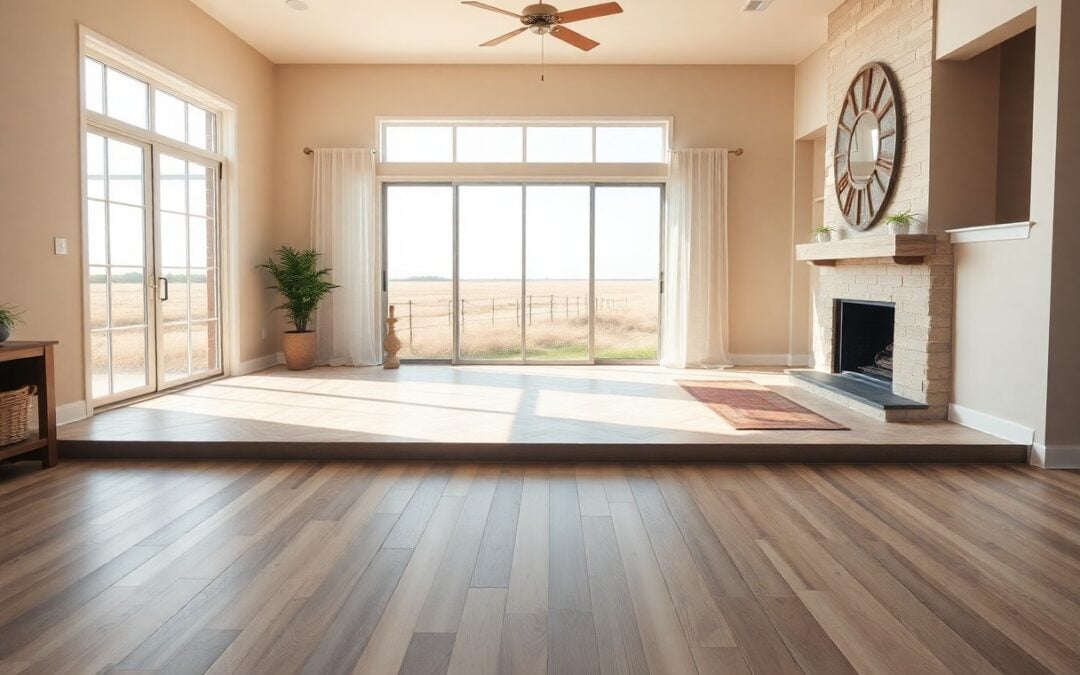
You should choose porcelain tile, luxury vinyl plank, or engineered hardwood in Anna, TX because these options resist heat and humidity, stay cooler underfoot, and require low maintenance.
Understanding the Impact of North Texas Heat on Flooring
Heat in North Texas forces your flooring to expand and dry out, increasing wear and energy load; choose materials that resist warping, reflect solar gain, and stay comfortable underfoot in long summers.
Thermal Expansion and Material Stability
Wood products often expand with heat, so you should prefer engineered planks or tile that hold dimensions and keep seams tight to avoid buckling and gaps.
Managing Humidity Fluctuations in Anna Homes
Homes in Anna face wide humidity swings; you should run HVAC or dehumidifiers and use proper moisture barriers to protect adhesives and prevent cupping or swelling.
When controlling humidity, aim for a stable indoor relative humidity between 35-50% year-round; you should acclimate new flooring on-site for 48-72 hours, test subfloor moisture before installation, and install a vapor barrier where recommended to extend service life and reduce maintenance.
Porcelain and Ceramic Tile: The Gold Standard for Cooling
Porcelain and ceramic tiles stay cool underfoot, so you can lower indoor temperatures in Anna’s heat. You benefit from light glazes and large formats that reflect sunlight and reduce heat retention, while easy cleaning helps tile feel fresh through humid Texas summers.
Natural Thermal Conductivity and Heat Dissipation
Tile’s thermal conductivity lets it absorb and disperse heat quickly, so you experience cooler floors and more stable indoor temperatures. You can boost this effect with daytime shading and strategic ventilation to move heat away faster.
Long-Term Durability and Moisture Resistance
Glazed porcelain resists wear and moisture, so you can install it in kitchens, mudrooms, and sunlit spaces without worry. You get minimal fading, simple maintenance, and lasting performance against Texas humidity.
Maintenance choices determine how long that durability lasts: you should choose porcelain with water absorption under 0.5% and a high PEI rating for heavy use, set it with polymer-modified thinset, and use epoxy or sealed grout. You must prepare the subfloor correctly and include movement joints; occasional grout sealing for porous tiles prevents mold and adhesive breakdown so your floors keep cooling efficiently and last for decades.
Luxury Vinyl Plank (LVP) for Climate Resilience
LVP gives you resilient, cool-underfoot flooring that handles Anna’s heat and sun exposure, resisting warping and fading while staying comfortable and low-maintenance through seasonal temperature swings.
Benefits of Rigid Core Technology in High Temperatures
Rigid-core planks give you dimensional stability in high heat, reducing expansion and contraction so seams stay tight and floors remain flat under intense Texas temperatures.
Rigid Core Features and How They Help You
| Feature | How it helps you |
|---|---|
| Stiff core | Prevents warping so your floor stays even despite heat spikes |
| Engineered thickness | Reduces movement, keeping seams tight and reducing repairs for you |
| Click-lock installation | Makes replacement or repairs faster while maintaining a reliable fit |
Waterproof Features for Local Weather Extremes
Waterproof LVP protects you from storms, irrigation overspray, and household spills, letting you clean up quickly without swelling, staining, or hidden subfloor damage.
You should choose fully waterproof cores (SPC or WPC) with sealed edges and a quality wear layer so moisture never reaches the substrate; proper installation and manufacturer warranties ensure lasting performance through Anna’s humid summers and occasional heavy rains.
Engineered Hardwood vs. Solid Wood in Texas
Engineered hardwood holds up better than solid wood in Anna’s wide temperature swings, so you should choose it where seasonal humidity and heat cause movement; solid planks may cup or gap unless conditions are tightly controlled.
Why Engineered Planks Withstand Seasonal Shifts
You’ll find engineered planks resist cupping and shrinking because cross-layered cores limit expansion, making them a practical choice for Anna’s hot, variable climate while still offering real wood tops for appearance.
Selecting UV-Resistant Finishes for Sunlit Rooms
Choose UV-resistant finishes to protect color and surface sheen in sunlit rooms; they help you avoid fading and frequent refinishing while maintaining the wood’s natural look under Anna’s strong sun.
Apply finishes with high UV blockers-aliphatic polyurethane, UV-cured coatings, or products with aluminum oxide-to preserve pigment and reduce yellowing; you should also choose lighter stains, add window treatments, and schedule periodic inspections to catch surface degradation early.

Polished Concrete for Maximum Thermal Mass
Polished concrete absorbs heat during peak sun, storing thermal energy and releasing it overnight, which smooths indoor temperature swings. In Anna’s summer, that thermal mass helps you reduce air-conditioning cycles and maintain consistent comfort with lower energy use.
Sustainable Cooling Properties for Modern Interiors
Concrete’s density and high specific heat let it act as a passive cooling buffer, so you rely less on mechanical cooling. With reflective sealers and light finishes, you can enhance this effect while keeping interiors modern and energy-friendly.
Low-Maintenance Benefits for Active Households
Sealed polished floors resist stains, require only occasional damp mopping, and avoid grout maintenance you get with tile. For busy households in Anna, that means less upkeep and quicker cleanup after outdoor activities.
You find that occasional sweeping and a damp mop keep polished concrete looking new, while periodic re-sealing (every 3-7 years depending on wear) restores shine. The surface resists dirt, pet claws, and tracked-in grit better than many options, so you spend less time on stains and replacements and more on living.
To wrap up
Presently you should favor porcelain tile, luxury vinyl plank, or sealed concrete in Anna, TX; these resist heat, humidity, and sun exposure while offering low maintenance and good cooling underfoot, with engineered hardwood as a warmer alternative when humidity control is ensured.
FAQ
Q: What flooring types handle Texas heat and humidity best in Anna, TX?
A: Porcelain and ceramic tile top the list because they stay cool, resist moisture, and tolerate high temperatures without warping. Engineered hardwood offers the look of wood with greater dimensional stability than solid hardwood, but it still needs humidity control. Luxury vinyl plank with an SPC (stone plastic composite) rigid core provides waterproof performance, good dimensional stability in heat, and a softer underfoot feel than tile. Natural stone stays cool but requires sealing and can be more expensive. Polished concrete is thermally stable and cool underfoot but can be hard and may need sealing to control moisture and stains.
Q: Is tile my best option for keeping the house cool and durable?
A: Tile is the best option for cooling and durability in Anna’s hot summers. Porcelain tile resists heat and moisture, has high wear ratings (look for PEI ratings 3-5 for residential use), and comes in large formats that reduce grout lines. Use a quality thin-set mortar, proper backer board or cement substrate, and expansion joints to prevent cracking. Expect tiles to feel cold in winter; area rugs can add warmth in cooler months. Professional installation and grout sealing improve long-term performance.
Q: Will luxury vinyl plank (LVP/LVT) handle extreme summer heat and sun exposure?
A: High-quality LVP/LVT with an SPC rigid core performs well under Texas heat and direct sunlight if the product is rated for high temperatures and UV exposure. SPC offers better dimensional stability than WPC (wood plastic composite) and floating installations require correctly sized expansion gaps to avoid buckling. Choose a thick wear layer (20-30 mil for heavy traffic) and a UV-stable finish. Avoid low-cost products that can expand or off-gas in extreme heat. Proper acclimation before installation reduces installation issues.
Q: How does engineered hardwood compare to solid hardwood in Anna’s climate?
A: Engineered hardwood is a better choice in Anna because its plywood or multi-ply core is more stable against humidity and temperature swings than solid hardwood. Engineered planks can be installed over concrete with proper underlayment or as floating floors. Maintain indoor humidity between about 35-55% with your HVAC and use a dehumidifier during humid months to minimize movement. Avoid solid hardwood in below-grade areas or over concrete slabs without a moisture barrier.
Q: What should I ask local Anna, TX flooring contractors or showrooms before buying?
A: Ask about local experience with Texas heat and humidity, specific product recommendations for Anna’s climate, and whether they perform moisture testing on concrete slabs (in-situ relative humidity or calcium chloride tests). Request warranty details for heat- and moisture-related issues, installation references from nearby jobs, and written specifications for subfloor prep, underlayment, and expansion joints. Request samples to view in your home lighting, ask about recommended acclimation times, and confirm repair or replacement policies for warranty claims.
About What flooring near me works best for Texas heat in Anna with Flooring Source of Texas
Homeowners searching for What flooring near me works best for Texas heat in Anna choose Flooring Source of Texas for quality materials, careful installation, and clear communication. Our Flower Mound team serves nearby DFW communities with hardwood, vinyl, tile, laminate, carpet, and remodeling support.
Request a free estimate for What flooring near me works best for Texas heat in Anna, browse our service areas, or contact us at (972) 778-6855. We help you compare flooring options, plan timelines, and finish the job cleanly.
Anna TX heat and slab-stable floors
Anna summers push slab temperatures and UV through big windows. Dimensionally stable rigid-core LVP and porcelain perform better than thin glue-down vinyl in those rooms. We also plan window-wall expansion details for Anna sunrooms.
What flooring near me works best for Texas heat in Anna TX? — local guidance from Flooring Source of Texas
Flooring Source of Texas helps homeowners in Anna, TX plan flooring and remodeling with clear product options, realistic timelines, and install crews that protect your home day by day. Our Flower Mound showroom at 1900 Long Prairie Rd Ste 116 is open for sample browsing, and we provide free on-site estimates across North Texas.
When we evaluate a home, we look at subfloor condition, moisture risk, transitions between rooms, stair strategies, and how the finished floor will live with pets, kids, and Texas heat. That practical checklist keeps flooring and remodeling from turning into change orders after demolition starts.
Popular materials for Anna, TX homes include waterproof luxury vinyl plank for kitchens and mudrooms, engineered hardwood for living areas that want natural grain, porcelain or ceramic tile for wet zones, and carpet where comfort matters most. We help you compare wear layers, core types, and maintenance so the quote matches how you actually use each room.
Call (972) 778-6855 or visit our contact page to schedule a free estimate. Explore related services on our Texas flooring and Texas remodeling pages, or review coverage on our service areas page.
Flooring Source of Texas has served DFW families for decades with straightforward pricing, careful prep, and clean job sites. Whether you are refreshing one room or remodeling multiple spaces in Anna, TX, we keep communication simple from sample selection through final walkthrough.
Flooring Source of Texas provides flooring installation and remodeling support across this community and the greater DFW area. From the first sample appointment in Flower Mound to the final walkthrough, we keep scope, product, and schedule aligned so homeowners know what happens each day on site.
Our crews install waterproof luxury vinyl, hardwood and engineered hardwood, ceramic and porcelain tile, carpet, and laminate. We also coordinate kitchen and bathroom remodeling work when flooring is part of a larger renovation. Moisture testing, flatness checks, and transition planning are part of the standard process—not optional extras.
Request a free estimate at (972) 778-6855 or through our contact page. Showroom: 1900 Long Prairie Rd Ste 116, Flower Mound, TX 75022. Browse flooring services, remodeling, and service areas to see how we help nearby cities with the same standards.